Species Spotlight: Red Columbine (Aquilegia canadensis)
This guest blog is part of a series of articles written by Mount Allison students, as part of a partnership between Nature NB and the Applied Native Plants and Pollinator Conservation course. Thanks to Dr. Emily Austen and the students for this ongoing collaboration!
By Zoé Rush
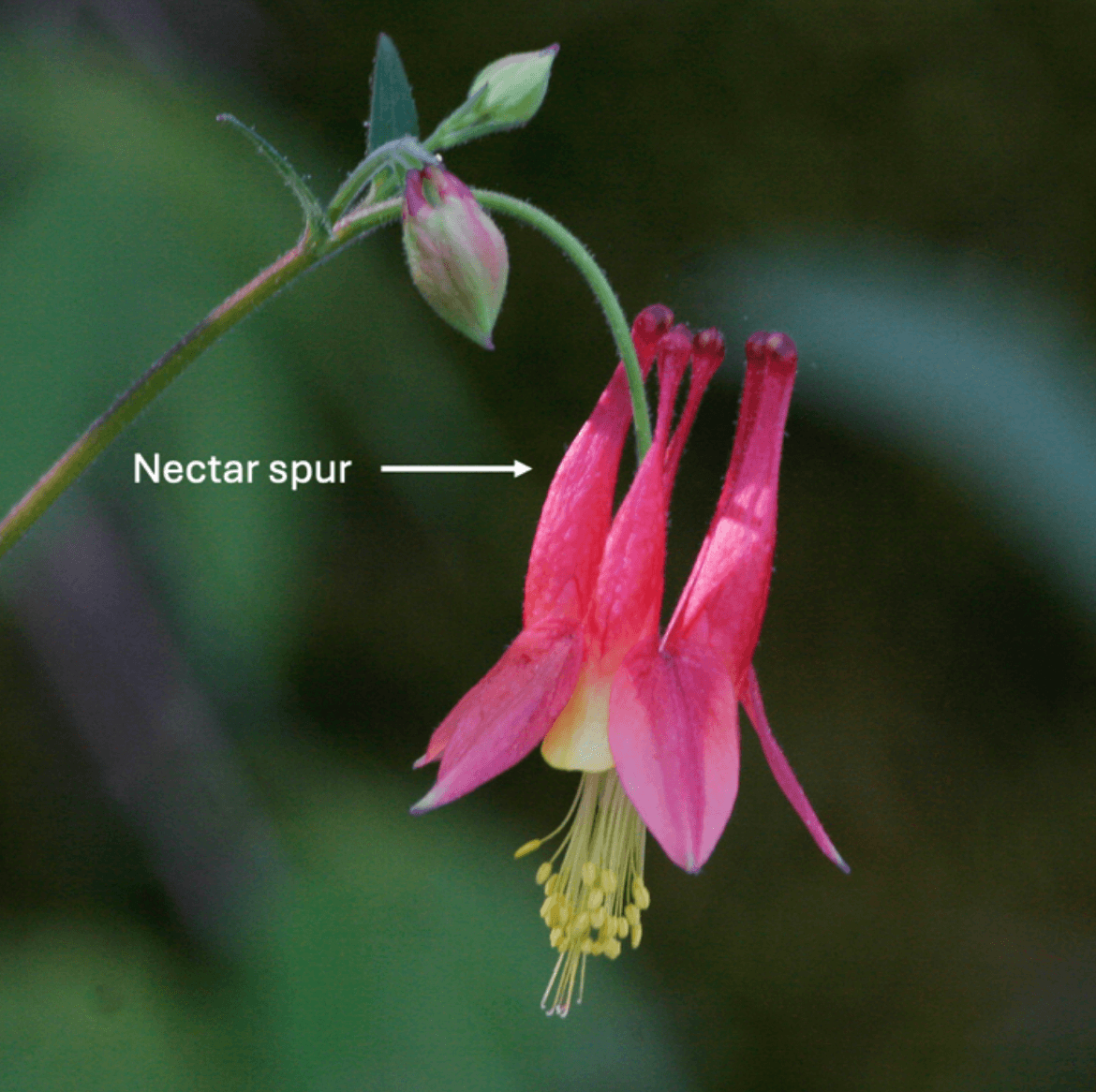
Red Columbine by Dan Vickers (2008) iNaturalist CC-BY / Addition of label
In the spring, when you start to think about what to plant in your garden, perhaps start to think about incorporating native plants. Aquilegia canadensis, more commonly known as the red columbine, is a flowering plant native to New Brunswick. Besides being a native plant, it has a variety of features that make it a great addition to your garden.
Red columbines are mainly pollinated by hummingbirds and bumble bees, which has considerably affected the way they look [3]. The North American columbine species differ from those in Europe greatly, which makes them easy to identify whether they are native or not. As there is no hummingbird presence and few hawkmoths in Europe, the nectar spur length of the columbines in North America have evolved to be longer with the presence of these pollinators [1]. The nectar spur can be seen in the picture to the left, and is the place where nectar is produced and stored.
If you wanted to identify this species from other columbines in North America, they have a unique identifier that allows them to be easily differentiated. Unlike other species, the red columbine has flowers that face downwards instead of up [2].
This plant species can most often be found in rocky areas and drier, woody areas across Eastern to Central North America [4]. Their five bright reddish outer petals and yellow tips stand out from their environments and provide a pop of colour [3]. It is a perennial that flowers in late spring. Red columbines have the highest chance of reseeding from the flowers earlier in the flowering season as the seeds are most viable then. This can be attributed to factors like soil moisture and light availability, as both generally decrease as the summer progresses [5,6].
An interesting feature of the red columbine is that they often self-pollinate. In naturally growing populations, red columbines have been found to use self-pollination in up to 76% of seed production. This is unusual for most flowering plants, but this species manages to keep features that most would lose due to self-pollination, allowing it to continually thrive [6].
These plants would make a great addition to any garden, with their lovely red flowers and their ability to draw hummingbirds. Seeds for the red columbine can be purchased online at a variety of places, including West Coast Seeds, Annapolis Seeds and Northern Wildflowers. Additionally, if you ever find one out in the wild, feel free to make an observation on iNaturalist. By doing this, the observation will be added to Nature NB’s native plant project, which collects identifications to provide insight into the biodiversity of native plants in New Brunswick.

References:
[1] Macior, L. W. (1966). Foraging Behavior of Bombus (Hymenoptera: Apidae) in Relation to Aquilegia Pollination. American Journal of Botany, 53(3), 302–309. https://doi.org/10.1002/j.1537-2197.1966.tb07340.x
[2] Whittall, J. B., & Hodges, S. A. (2007). Pollinator shifts drive increasingly long nectar spurs in columbine flowers. Nature, 447(7145), 706–709. https://doi.org/10.1038/nature05857
[3] Payson, E. (1918). THE NORTH AMERICAN SPECIES OF AQUILEGIA. Contributions from the United States National Herbarium, 20(4). https://www.jstor.org/stable/pdf/23492230.pdf
[4] Herlihy, C. R., & Eckert, C. G. (2005). Evolution of self-fertilization at geographical range margins? A comparison of demographic, floral, and mating system variables in central vs. peripheral populations of Aquilegia canadensis (Ranunculaceae). American Journal of Botany, 92(4), 744–751. https://doi.org/10.3732/ajb.92.4.744
[5] Kliber, A., & Eckert, C. G. (2004). Sequential decline in allocation among flowers within inflorescences: proximate mechanisms and adaptive significance. Ecology, 85(6), 1675–1687. https://doi.org/10.1890/03-0477
[6] Eckert, C. G., & Herlihy, C. R. (2004). Using a cost-benefit approach to understand the evolution of self-fertilization in plants: the perplexing case of Aquilegia canadensis (Ranunculaceae). Plant Species Biology, 19(3), 159–173. https://doi.org/10.1111/j.1442-1984.2004.00112.x