
This article was published in the 50th volume of the NB Naturalist, in June 2026. Read it in full or find out where to order it here.
NB Naturalist Feature – Volunteers with the Saint John Naturalist Club Monitor OE Infection Rates in Monarchs
Hugh Hartloper and Keeghan Stephens (Mount Allison University)
Ophryocystis elektroscirrha (OE) is a protozoan parasite that infects monarch butterflies (Danaus plexippus). It is present in all monarch populations [1, 2]. Monarchs infected with OE are less likely to survive their larval stage, have more fragile wings as adults, and have shorter lifespans [1]. OE can be transferred between mothers and their offspring, between adults during close contact and mating [3], and when a caterpillar consumes spores shed onto a milkweed plant by an infected butterfly [4]. Monarchs at the very northern edge of their migratory range, including New Brunswick (NB), experience lower OE infection rates, demonstrating the importance of conserving monarch habitat in these regions [5].
The OE lifecycle begins when a caterpillar ingests spores. The spores release cells that migrate through the gut wall to the tissues that later become the scales of the adult butterfly [1,6] As the monarch metamorphosizes, the OE cells produce millions of spores that emerge on the adult scales, enabling external transmission [6, 7]. The presence of OE spores also hinders the process by which pupae inflate their wings with fluid, altering wing structure and density [8], and potentially contributing to the reduced migration success of infected Monarchs [3].
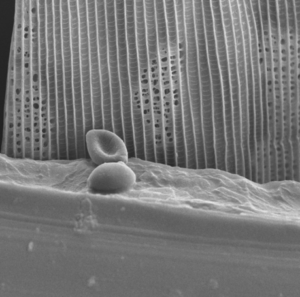
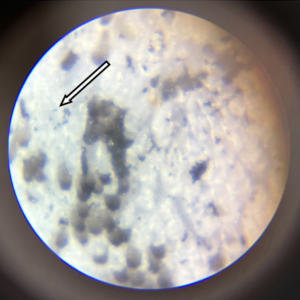
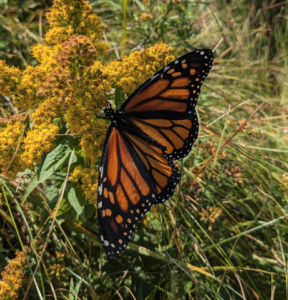
Volunteers with the Saint John Naturalist Club (SJNC) have been monitoring the presence of OE on migratory monarchs at Point Lepreau since 2021, as part of their work on the Monarch Watch Tagging Program (Fig 1B). As one of the most southern locations in the province, Point Lepreau is an important funnel-point for migrating monarchs. The volunteers measure, tag, and rerelease monarchs to track their migration patterns. Spores are difficult to see by the naked eye, so to diagnose an OE infection, a piece of tape is pressed against the abdomen of a monarch, and then applied to a piece of white paper and viewed under 30-40x magnification. The OE spores look like vanilla bean seeds between the monarch scales (Fig. 2A). We also examined spores provided by the Canadian Wildlife Service at much higher magnification using scanning electron microscopy (Fig. 2B). At this scale, they are similar in size and shape to a red blood cell: ~10 µm in diameter, oval, and concave on one side.

We digitized and analyzed the SJNC’s monarch data for 2023 and 2024 to get an idea of how our monarch population is faring. Of 98 monarchs tested in 2023, 2% carried external spores, and of 324 tested in 2024, 9% carried spores. Reassuringly, these rates are lower than those observed elsewhere in the monarch range, e.g. ≥20% at the end of the breeding season in some years in the Eastern US [3]. There were other differences, too. Whereas in other parts of the range, females experience greater infection intensities than males [9], and the higher infection severity of females has been suggested as a possible cause of male-biased sex ratios among migrating monarchs [10], we did not see a sex difference in infection probability in NB.
Similarly, infected monarchs tend to be smaller than uninfected individuals in other areas [1], with a larger mass effect in females [9], but in NB, we did not see any association between infection status and size in males or females. Symptoms of infection can vary with the severity of the infection. Overall, the data collected by SJNC suggest that OE infection loads in NB are not very high, which reinforces the importance of northern regions for monarchs.
Situated at the northern limit of the monarch butterfly’s range, conservation work in NB may be important to conserving the species in the face of OE and other threats. Infected monarchs struggle to reach this far north, and those infected here struggle to return to their overwintering grounds to engage in horizontal transmission of the parasite. Those healthy enough to make it to NB reduce their exposure to heavily contaminated southern regions. It is therefore important that we maintain habitat to support monarch populations. Planting milkweed is an excellent step: the more milkweed available, the more that monarch egg-laying is spread out between multiple plants, which can help limit OE contamination of individual plants [3]. We can also support monarchs, as well as other pollinators, by planting and conserving native wildflowers to provide nectar. Finally, ongoing efforts of groups like the SJNC are critical to monitoring and maintaining the health of monarchs in our region.
Acknowledgements
We wish to thank Jim Wilson, Jean Wilson, and other members of the SJNC for their dedicated work collecting monarch data, and Kathleen Duguay at NB Power for facilitating access. Thanks to the Canadian Wildlife Service for providing OE samples, and to Jim Ehrman for imaging them under SEM. This article was written as part of a Mount Allison University course run in cooperation with NatureNB, and funded by a grant from Co-operative Education and Work-Integrated Learning Canada. The article was edited by the course instructor, Dr. Emily Austen.
References
- Altizer SM, and KS Oberhauser. 1999. Effects of the protozoan parasite Ophryocystis elektroscirrha on the fitness of Monarch Butterflies (Danaus plexippus). 1999. Journal of Invertebrate Pathology 4: 76-88
- Gao K, D Muijderman, S Nichols, DG Heckel, P Wang, MP Zalucki, and AT Groot. 2020. Parasite-host specificity: A cross-infection study of the parasite Ophryocystis elektroscirrha. Journal of Invertebrate Pathology 170: 107328
- Bartel RA, KS Oberhauser, JC de Roode, and SM Altizer. 2011. Monarch butterfly migration and parasite transmission in eastern North America. Ecology 92: 342-351
- Project Monarch Health. University of Georgia, Athens GA. https://www.monarchparasites.org/oe
- Dargent F, SM Gilmour, EA Brown, R Kassen, and HM Kharouba. 2021. Low prevalence of the parasite Ophryocystis elektroscirrha at the range edge of the eastern North American monarch (Danaus plexippus) butterfly population. Canadian Journal of Zoology 99: 409-413
- McLaughlin, RE, and J Myers. 1970. Ophryocystis elektroscirrha sp. n., a neogregarine pathogen of the Monarch Butterfly Danaus plexippus (L.) and the Florida Queen Butterfly D. gilippus Berenice Cramer. Journal of Protozoology 17: 300-305
- Satterfield DA, AE Wright, and S Altizer. 2013. Lipid reserves and immune defense in healthy and diseased migrating monarchs Danaus plexippus. Current Zoology 59: 393-402
- Davis AK, and JC de Roode. 2018. Effects of the parasite, Ophryocystis elektroscirrha, on wing characteristics important for migration in the monarch butterfly. Animal Migration 5: 84-93
- de Roode, JC, LR Gold, and S Altizer. 2007. Virulence determinants in a natural butterfly-parasite system. Parasitology 134: 657-668
- Davis, AK, and E Rendón-Salinas. 2010. Are female monarch butterflies declining in eastern North America? Evidence of a 30-year change in sex ratios at Mexican overwintering sites. Biology Letters 6: 45-47


